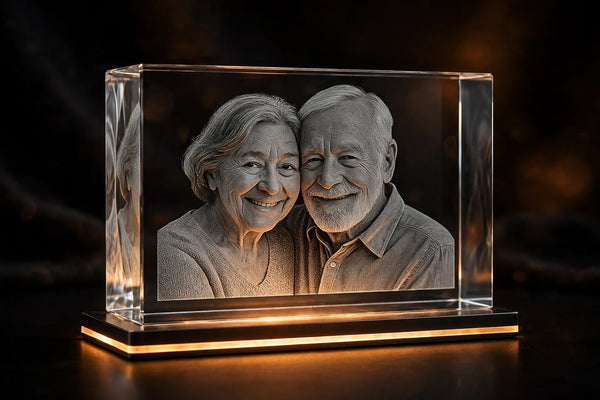
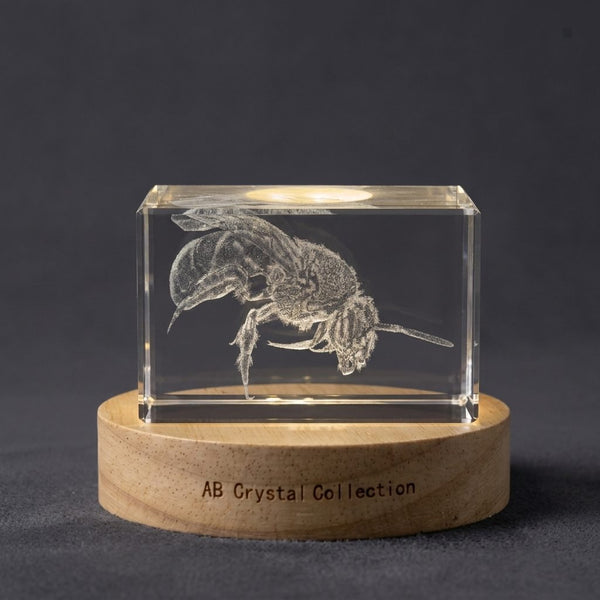
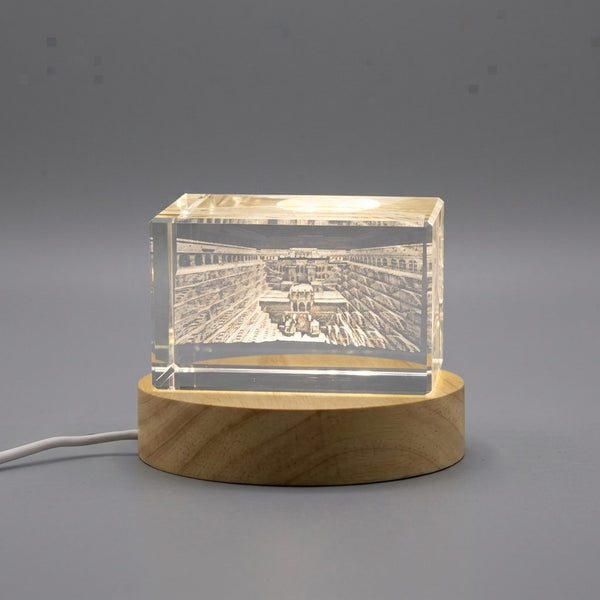
Hold a 3D crystal photo gift up to the light and tilt it slowly. The portrait inside moves with you — a face, a family, a beloved pet — floating in the middle of solid glass, as if someone froze a memory in ice. The first question almost everyone asks is the same: how did they get a photo inside there?
It isn't printed. It isn't etched on the surface. And it isn't a hologram. What's actually inside the glass is something far more interesting: thousands of microscopic marks, placed one by one by a laser beam, at exact points in three-dimensional space. This is subsurface laser engraving — and understanding it changes the way you see these keepsakes. Here's the science, explained simply.
If It's Not Printed and Not Etched on the Surface, What Is It?
When most people hear "engraving," they picture something carved into a surface — letters chiseled into a tombstone, a name etched onto a trophy plate. Subsurface laser engraving works nothing like that. The surface of the crystal stays perfectly smooth. Run your finger across it and you'll feel nothing at all.
Instead, a focused laser beam passes straight through the outer layers of the glass without marking them, and fires only where it converges to a pinpoint focus deep inside the material. At that focal point, the energy is so concentrated that it creates a tiny micro-fracture — a "dot" roughly the size of a grain of dust — frozen permanently inside the crystal.
Each engraved crystal is built from tens of thousands of these micro-dots, each one placed at a precise 3D coordinate. Together, they scatter the light that passes through the glass, and your eye reads them as a glowing image. No ink, no paint, no chemicals, no layer stuck onto anything. The image is the glass itself, marked at points inside it.
This is also why the crystal never feels rough or "printed on." The surface is untouched from start to finish — which is exactly why the image can't wear away from the outside. More on that below.
How Does a Laser Draw Thousands of Microscopic Dots Inside Solid Glass?
The magic is in a phenomenon called nonlinear absorption — which sounds complicated, but the idea is beautifully simple. Glass is transparent to the laser's wavelength, so the beam travels through it freely, like sunlight through a window. Nothing happens along the way.
But the laser is pulsed — it fires in extremely short bursts, lasting only billionths of a second. Optics focus all those pulses down to a single microscopic point. Only at that exact focal point does the energy density get high enough to briefly alter the glass itself, creating one tiny mark. Move the focal point a fraction of a millimeter, fire again, and you've made the next dot.
A computer-controlled system sweeps that focal point through the crystal in three dimensions, following a digital 3D model of your photo. It places up to 1,000 dots per second, layer by layer, until the whole portrait has been "printed" in space. A detailed portrait can contain 100,000 or more individual micro-dots.
And here's the part that surprises people: the process is entirely digital and repeatable. Your photo is first converted into a 3D depth map — darker and lighter areas become different depths and densities of dots — and then the machine reproduces it inside the glass with mechanical precision. The laser never touches the surface because it doesn't have to.
This precision is exactly why size matters so much. On a larger crystal, those thousands of dots have more room to spread out, so fine details — the catchlight in an eye, individual strands of hair — render more clearly. That's the whole point of a large format piece:

Why Does the Image Look 3D — Like It's Floating Inside the Crystal?
A flat printed photo has two dimensions. The engraved image has three, because the dots genuinely occupy depth. The laser places marks at different distances from the front face of the crystal, so darker areas of the original photo sit deeper, lighter areas sit shallower, and the whole portrait gains real volume.
As you tilt the crystal, your two eyes see the dot cloud from slightly different angles — the same parallax effect that gives you depth perception in real life. Your brain fuses those two views into a single solid-looking image that appears to hover in the middle of the glass. Rotate it, and the portrait turns with it, like a tiny sculpture you can walk around.
Light does the rest of the work. The polished faces of the crystal bend and channel incoming light, and each micro-dot scatters a little of it back toward your eye. That's why the image seems to glow softly even in ordinary room light — and why it looks so different from a flat print behind glass. The image doesn't sit on anything. It exists in space, inside the material.
Want to see this effect at its most dramatic? Place the crystal on a light source and watch the dots ignite:

What Is "Optical Crystal," and How Is It Different From Regular Glass?
Not all glass is equal, and the material matters enormously for this kind of engraving. The crystals used for 3D engraving are optical crystal — a high-purity glass with exceptional clarity and light transmission, far clearer than the glass in an ordinary window or drinking glass.
Regular glass contains tiny impurities, bubbles, and color tints (that greenish edge you see on thick window glass is iron contamination). Those flaws would scatter the laser beam, blur the focal point, and show up as cloudy patches in the finished image. Optical crystal is manufactured to eliminate them: it transmits over 90% of visible light and is free of the streaks and seeds that would interfere with a pinpoint laser focus.
The material is also physically uniform — same density everywhere — so the laser's focal point lands exactly where the software aims it, thousands of times in a row. That uniformity is part of why the dots are so consistent in size and brightness, and why the finished portrait looks smooth instead of grainy.
There's a tactile difference too. Optical crystal is noticeably heavier and clearer than ordinary glass; it has that satisfying heft and water-clear edge that signals quality the moment you pick it up. If you've ever wondered why these keepsakes feel so substantial compared to a glass paperweight from a gift shop — this is why.
Why Can the Engraving Never Fade, Peel, or Scratch Off?
Think about how every other kind of image ages. Inkjet prints fade in sunlight. Photographs yellow. Stickers peel. Surface etching wears down with handling and polishing. Every one of those images lives on something — and the surface is where all the damage happens.
The engraved image lives inside the crystal, sealed beneath millimeters of solid glass on every side. Sunlight can't bleach it because there's no pigment to bleach. Fingers can't smudge it because no finger will ever reach it. Cleaning products can't dissolve it because there's nothing to dissolve.
The micro-fractures themselves are structurally stable — they're part of the glass now, not a coating applied to it. Short of shattering the crystal itself, there is no physical mechanism by which the image can degrade. It doesn't fade over decades. It doesn't need to be kept out of the sun, reframed, or restored.
That's the real promise of the technology, and it's worth stating plainly: a 3D crystal portrait is designed to look exactly the same for generations — which is precisely why people choose it for the memories that matter most. Weddings, new babies, a parent's smile, a pet who isn't here anymore. These are the images you want to outlast you, and the physics is on your side.
If you're thinking about turning one of your own photos into a crystal, the collection covers every size and occasion:
What Does This Mean for Your Photo? Understanding Resolution and Detail
Now for the practical question: given that the image is made of dots, how detailed can it actually be? The honest answer is remarkably detailed — but the physics sets real limits, and knowing them helps you choose the right photo.
Resolution scales with size. A small crystal simply has less volume for dots, so the finest textures blur together. A large rectangle, on the other hand, can resolve facial features, fabric folds, and fur texture with startling fidelity. If your photo is a group shot with five faces, choose the biggest format you can — every extra inch is more dots per face.
Contrast matters more than megapixels. The engraving renders in monochrome — shades of grey formed by dot density — so a photo with strong light-and-dark separation converts beautifully, while a washed-out, low-contrast snapshot converts muddily. You don't need a professional camera; you need clear separation between your subject and the background.
Simple backgrounds win. Because depth in the engraving comes from tonal differences, a busy background competes with your subject for dots. Portraits taken against plain or softly blurred backgrounds produce the cleanest, most striking crystals. If your favorite photo has a cluttered background, don't worry — the design team typically simplifies it during the 3D conversion.
Faces should be large in the frame. A face that fills a good portion of the photo gives the laser the most dot-density to work with. A tiny figure in a landscape will engrave as a tiny figure — recognizable, but without the breathtaking detail of a close portrait. When in doubt, crop closer.
None of this requires you to become a photographer. It just means that the photo you'd instinctively pick as "the good one" — clear, well-lit, subject front and center — is almost always the right one for crystal too.
Frequently Asked Questions
Is the image painted or colored inside the glass?
No. There is no paint, ink, or colorant anywhere in the process. The image is formed entirely by microscopic fractures in the glass itself, which scatter light and appear as shades of grey. That's why the engraving can never fade — there's nothing in it that can fade.
Can the engraving be done on the surface instead, like traditional etching?
It could, but that would defeat the purpose. Surface etching sits exposed to air, fingers, and cleaning — it wears, collects dirt in the grooves, and eventually dulls. Subsurface engraving seals the image inside solid crystal, which is exactly what makes it permanent.
How long does it take to engrave a single crystal?
The laser engraving itself typically takes 30 minutes to a few hours depending on the size and detail level — a large portrait with 100,000+ dots simply takes longer to place than a simple design. The 3D conversion of your photo and quality checks add to the total production time before shipping.
Does the image show correctly from all sides?
The portrait is oriented to be viewed from the front face, but because the dots genuinely occupy 3D space, the image remains visible — shifting in perspective — as you rotate the crystal. Viewed from directly behind, you'll see a mirror image, exactly as you'd expect from a real object floating in glass.
Key takeaways
- Subsurface laser engraving places tens of thousands of micro-dots at precise 3D coordinates inside solid crystal — the surface stays perfectly smooth.
- The laser passes harmlessly through the glass and marks only at its pinpoint focal point, firing in billionths-of-a-second pulses.
- The image looks 3D because the dots genuinely occupy depth — parallax does the rest as you tilt the crystal.
- Optical crystal transmits over 90% of visible light and is impurity-free, which is what makes the pinpoint focus possible.
- With no ink, paint, or surface layer, the engraving cannot fade, peel, or scratch off — it's designed to last generations.
- Bigger crystals resolve more detail, and high-contrast photos with simple backgrounds convert best.
So the next time you hold one of these crystals, you'll know what you're really looking at: not a print, not an etching, not a trick of the light — but a portrait drawn in three dimensions, one microscopic dot at a time, sealed inside glass forever. Now that you know what's inside the glass — put your own story in there.