You know the drawer. Every traveler has one. It holds a magnet shaped like a gondola, a miniature leaning tower that leans a little too far, a plastic snow globe whose glitter has clumped into a sad white iceberg. They were joyful purchases — proof that you were there. But somehow, back home, they never earn a place on a shelf.
The problem is not the sentiment. The problem is the object. Most souvenirs were designed to be bought in thirty seconds at an airport shop, not to live with you for years. A 3D-engraved crystal monument flips that logic: it starts from the opposite end — a piece of home decor that happens to carry your trip inside it.
A landmark laser-engraved in grey inside a block of crystal does not fade, peel, chip or yellow. It just stands there, quiet and precise, until the light catches it — and suddenly you are back on the Champ de Mars at dusk, or watching the Dubai skyline shimmer in the heat. Here is a world tour of the monuments worth keeping, and how to give them the shelf they deserve.
Why do travel souvenirs always end up in a drawer?
Because most of them are made to be sold, not to be kept. A fridge magnet is a receipt with glue on the back — it says "I went to Rome" without ever reminding you how Rome felt.
The souvenirs that survive the years share three qualities: they are beautiful enough for a living room, durable enough for decades, and specific enough to hold a memory. A mass-produced miniature is none of these. It is too generic to be personal, too cheap to age gracefully, and too kitschy to display next to objects you actually chose.
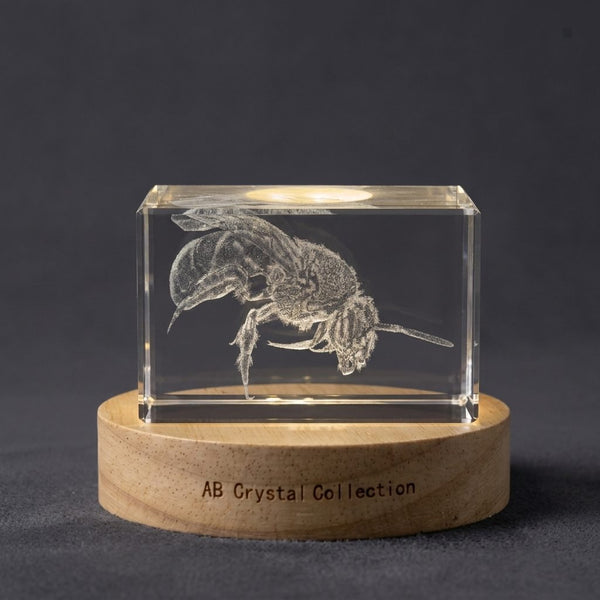
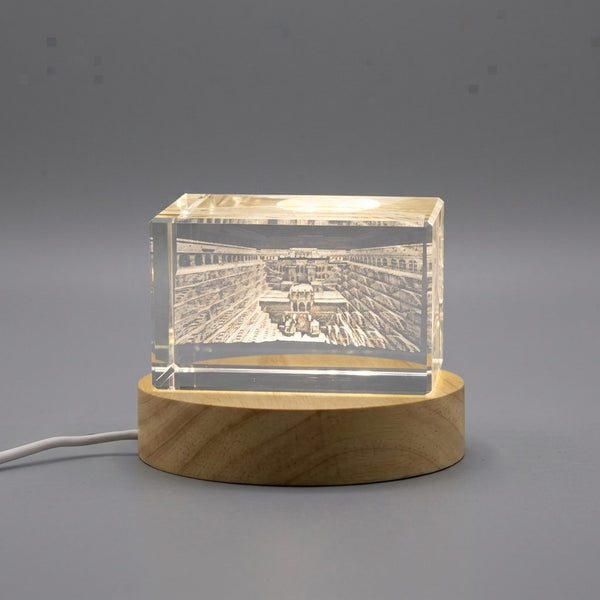
A crystal monument works for the opposite reason. Laser engraving places the landmark inside the crystal — thousands of tiny engraved points suspended in glass, forming a three-dimensional miniature you can walk around with your eyes. There is nothing to peel, chip, fade or yellow, because the image never touches air, fingers or sunlight directly. A crystal engraving keeps its precision for decades, not seasons.
It also changes the register of the gift. A magnet says "I thought of you at the airport." A crystal monument says "I saw this, and I wanted you to have it properly." For a traveler, it is a travel diary in solid form; for the person who stayed home, it is the closest thing to being brought along.
Why is the Eiffel Tower the perfect first crystal monument?
Paris is the most-visited city on the planet, and the Eiffel Tower is the most recognizable monument ever built — which makes it the safest souvenir gift in existence and, paradoxically, the hardest to get right. Everyone has seen a bad Eiffel Tower. A crystal one is where the iron lady finally gets the dignity she deserves.
In 3D laser engraving, the tower's latticework is the star. The laser renders the iron arches point by point, so the structure reads from every angle as it rotates in the light. The grey engraving against clear crystal gives it the quality of an architectural model or an old engraving plate — precise, monochrome, almost museum-like.
It is also the monument with the most universal emotional charge. Even people who have never been to Paris have a relationship with the tower — from films, from photographs, from the collective imagination. That is why an Eiffel Tower crystal works as a gift for travelers and non-travelers alike. For the traveler, it anchors a real memory; for everyone else, it is simply a beautiful object.
Place it where the evening light reaches it — a bookshelf, a desk, a mantelpiece. When the room dims, the tower glows from within, and for a moment you are standing on the Trocadéro again, watching the hourly sparkle. No magnet has ever done that.

What about Dubai and London — which monuments should I pick?
Dubai and London sit at opposite ends of the travel-souvenir spectrum. Dubai is vertical ambition — the Burj Khalifa, at 828 meters, is the tallest building in the world — while London is layered history, where Big Ben, Tower Bridge and the London Eye compete for skyline space. A crystal monument handles both surprisingly well, because 3D engraving loves strong silhouettes.
The Burj Khalifa is a gift to the laser. Its stepped, needle-like profile is unmistakable even at a few centimeters tall, and the engraving captures the tiered setbacks that make the real tower shimmer. In crystal, the world's tallest building becomes a desk-sized meditation on ambition. It suits the traveler who came home from Dubai talking about scale — everything there is the biggest, the tallest, the newest — and wants one object that says it without shouting.
London is trickier, because no single monument owns the city. That is why a landmarks composition — Big Ben's clock tower, the wheel, the bridge — works better than any one of them alone. A multi-landmark engraving reads as a city portrait rather than a postcard. For someone who lived in London, studied there, or honeymooned along the Thames, the cluster of silhouettes triggers the whole map at once.
Both make excellent "second souvenir" gifts: the Eiffel Tower for the classic trip, Dubai or London for the trip that surprised you.


How does the Statue of Liberty translate into crystal?
New York souvenirs have a particular challenge: the city sells itself so aggressively that most keepsakes feel like Times Square merchandise. The Statue of Liberty deserves better — she is, after all, a 93-meter symbol of welcome that has greeted arrivals since 1886.
In crystal, Lady Liberty gains something the harbor never gives her: stillness. The engraving freezes the raised torch, the crown's seven spikes, the draped robe, in a medium that asks you to slow down and look. Grey monochrome suits her especially well — it echoes the statue's own weathered copper-green patina in the language of engraving.
This is the monument for the American trip with emotional weight: the first visit to New York, the immigration story in the family, the graduation trip, the "we finally made it" honeymoon. A crystal Statue of Liberty does not say "I bought this at JFK." It says "this crossing mattered."
It also pairs beautifully with the Eiffel Tower — the two were, after all, designed by the same engineering lineage, and France gifted the statue to America. A Paris–New York crystal pair tells a transatlantic story on a single shelf.

Why does Mont-Saint-Michel look so striking in 3D engraving?
Some monuments are famous; Mont-Saint-Michel is haunting. A Gothic abbey rising from a tidal island off the Normandy coast, it looks less built than dreamed — which is exactly why flat souvenirs fail it and 3D engraving flatters it.
The abbey's power is vertical layering: village, ramparts, church, and the spire climbing toward the sky in one continuous silhouette. 3D laser engraving captures that layering better than any photograph, because you see the depth the camera flattens. Turning the crystal slightly reveals the island's tiers the way the tide reveals them — gradually.
It is also the connoisseur's pick. Everyone gives the Eiffel Tower; Mont-Saint-Michel signals a traveler who went beyond the obvious — the Normandy road trip, the pilgrimage route, the France that guidebooks relegate to page 214. As a gift, it flatters the recipient's taste. As a personal keepsake, it marks the trip you still talk about years later.
For francophiles and romantics, it is arguably the most beautiful object in the monument series — the French touch, in the most literal sense.

How should I display a crystal monument to get the full effect?
A crystal monument without light is a beautiful paperweight. With light, it is a small theater. The difference is not subtle — it is the difference between an object and an experience.
The single most important display decision is the base. A lighted LED base, especially in warm white, transforms the engraving: the grey points catch the light and the monument appears to float, glowing from within. Wooden bases add warmth and suit classic interiors; the glow itself does the storytelling. Place the piece where you will see it in the evening — a side table, a bookshelf at eye level, a desk corner — because crystal monuments are creatures of low light.
A few practical rules. Keep the crystal out of direct, prolonged sunlight — not because the engraving fades (it cannot), but because a crystal block can focus light like a lens. Dust it with a soft, dry cloth; avoid abrasive cleaners that could dull the polished faces. And give it space: a monument crowded between books reads as clutter, while the same piece alone on a small stack of travel books reads as a shrine.
For collectors, the display logic scales beautifully. Two or three monuments — Paris, New York, Dubai — arranged at slightly different heights become a personal skyline, a world tour you can rearrange. Each piece is made in Canada and priced at $59.99, so building a small collection stays reasonable.
Key takeaways
- Most souvenirs fail because they are made to be sold, not kept — the ones that last are beautiful, durable and specific.
- 3D laser engraving places the monument inside the crystal, where it cannot peel, chip, fade or yellow — it keeps its precision for decades.
- A lighted LED base in warm white is the single biggest upgrade — it makes the engraving glow from within.
- Each crystal monument is made in Canada and priced at $59.99, so a Paris–New York–Dubai trio stays affordable.
- Keep crystal out of prolonged direct sunlight and dust it with a soft, dry cloth — no abrasive cleaners.
Frequently asked questions
How long does a 3D laser engraving inside crystal last?
Essentially indefinitely. The image is not printed on the surface — it is a cloud of microscopic engraved points suspended inside the glass. Because the engraving never touches air, fingers or sunlight, it cannot peel, chip, fade or yellow. The crystal itself is as durable as glass: it will outlive the shelf it stands on.
Does a crystal monument need a lighted base?
It does not need one to be beautiful, but light is what unlocks the full effect. An LED base shines up through the crystal and makes the grey engraving glow, revealing depth you miss in daylight. Warm white suits classic interiors; the monuments are designed to sit on standard lighted display bases.
Can I personalize a crystal monument with a name or date?
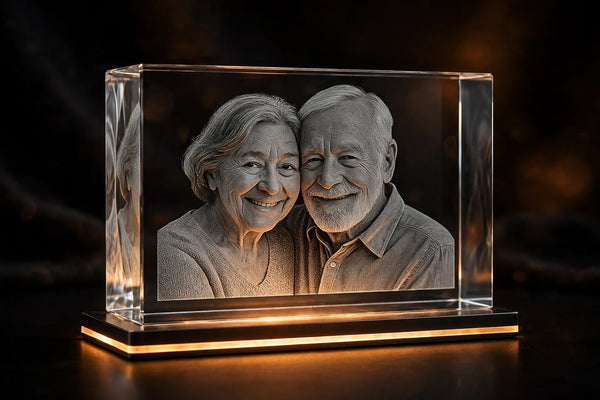
The monument engravings themselves are fixed designs, but many travelers pair them with a personal touch — a handwritten note with the trip dates tucked under the base, or a second custom crystal engraved with a travel photo. For fully personal pieces, our custom 3D photo crystals turn your own pictures into the same grey-engraving style. The monument marks the place; the personal crystal marks the moment.
How do I clean a crystal keepsake without damaging it?
Less is more. Dust with a soft, dry microfiber cloth; for fingerprints, breathe lightly on the surface and wipe gently. Avoid abrasive cleaners, scouring pads and ammonia-based sprays, which can dull the polished faces over time. Never submerge a piece that sits on an electronic LED base.
A souvenir should not be a receipt for a trip. It should be the trip, distilled — the evening light on the tower, the impossible height of the Burj, the torch in the harbor, the abbey rising from the tide. Bring your travels home in light: explore our crystal monuments.