Your phone holds thousands of photos of your newborn — and yet something in you still wants one you can actually hold. Here's how to turn a single perfect image into a keepsake that outlives the scroll.
The first week home with a baby is a blur of feedings, 3 a.m. wake-ups, and — somehow — a camera roll that grows by a hundred photos a day. You'll take a picture of every yawn, every fist curled around a finger, every improbable sleeping position. And then one evening, scrolling through the thousands you've already captured, a strange feeling arrives: 10,000 photos on a phone can still feel like nothing you can touch.
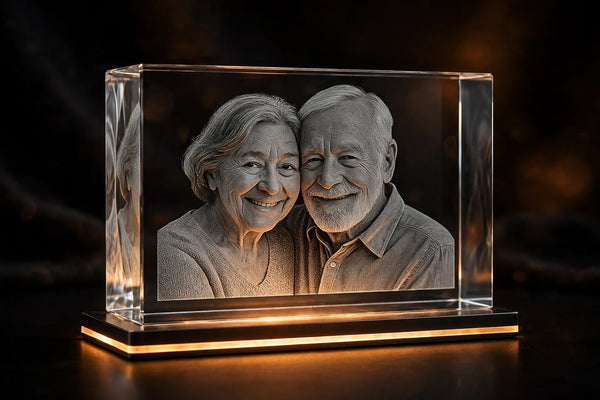
That's the gap a 3D crystal keepsake fills. A laser-engraved crystal is a physical object — a sleeping newborn portrait suspended inside polished glass, lit softly from its wooden base. It doesn't get buried under screenshots, it never needs charging, and it still looks the same decades later as the day it arrived. This guide walks you through choosing the photo, the timing, the shape, and — for grandparents reading this — the etiquette, so the keepsake feels right for everyone.
Why do 10,000 phone photos still leave new parents wanting something tangible?
Psychologists call it the "photo-taking impairment effect": when we capture everything, we sometimes remember less. But the deeper reason is simpler — a phone photo is an image you look at, while a keepsake is an object you live with.
A crystal sits on the nursery shelf. Guests pick it up, turn it in the light, and the newborn's face floats inside the glass from every angle. A phone screen holds 10,000 images; a crystal holds one — and that one gets seen every day.
There's also permanence. Cloud accounts change, phones get replaced, and formats fade — K9 optical crystal does not fade, yellow, or degrade over time. A crystal engraved the week your child is born can be handed to that child at twenty-five in exactly the condition it left the workshop. That's the whole case: not more photos, but one photo that survives everything else.
Ask any parent a year later which objects they treasure from the newborn days. The answers are rarely the expensive ones — the hospital bracelet, the first tiny hat, the blanket that went everywhere. A crystal joins that quiet company: small enough to keep forever, special enough to never be put in a drawer. Where a phone photo asks to be swiped past, a keepsake asks to be picked up — and that difference is felt by everyone who holds it.
Which newborn photo engraves best in 3D?
The laser that engraves your photo reads contrast and depth, not color. Every engraving converts your image into thousands of tiny laser points inside the glass — areas that are dark in the photo become dense and bright inside the crystal, and bright areas stay clear. So the rules for choosing are the opposite of what works on Instagram:
Sleeping close-ups beat wide awake smiles. A peacefully sleeping newborn — face filling most of the frame, eyes closed — gives the laser one clean subject with deep natural shadows. These engrave into the most lifelike results because the face is still, round, and evenly lit.
Simpler backgrounds engrave cleaner. A busy patterned blanket or a cluttered nursery wall competes with the subject. A photo taken against a plain blanket, a white onesie, or even just swaddling fabric keeps the laser's attention exactly where it belongs: on the baby.
Side light is your friend. Photos taken near a window, where light rakes gently across the face, carry the kind of shading the engraving loves. Direct flash, on the other hand, flattens everything — and flat photos engrave flat. Soft window light from one side produces the deepest, most three-dimensional engraving.
And don't worry about color: black-and-white photos convert beautifully, but color photos engrave just as well — the process reads light and dark, so a color image simply becomes a luminous grey-scale portrait inside the glass.

What tiny details engrave most beautifully — hands, feet, first yawns?
Some of the most moving baby crystals aren't faces at all. Parents who choose detail shots are often the happiest with the result, because tiny details engrave with astonishing sharpness:
A fist around a finger. The contrast between the baby's tiny hand and the adult finger it grips reads beautifully to the laser. It's a one-image story about scale — how small they were, how fiercely they held on.
Feet, especially newborn feet. The wrinkles, the miniature toes, the curve of the sole — detail that melts everyone. A close-up of newborn feet is one of the most-requested engraving subjects of all, and it works in almost any crystal shape.
Profile portraits and yawns. A baby's profile — nose, lashes, lips in soft relief — carries gorgeous depth. And a mid-yawn shot, while almost impossible to catch on purpose, is pure gold when you do: the open mouth and scrunched eyes give the engraving wonderful dimension.
A swaddled silhouette. The classic: baby wrapped snug, face peeking out. The fabric's folds give the laser rich texture to work with, and the result looks like a tiny sculpture floating in glass — because, inside the crystal, it is one.
A practical tip: check your photo at 100% zoom before choosing. If the detail you love — the lashes, the fingers — stays crisp at full size, the engraving will hold it too. A blurry original can only engrave blurry.
When should I order — and how long does the engraving take?
The honest answer: order within the first weeks, when the "brand new" details — the wrinkled hands, the newborn proportions — are at their most distinctive. You don't need a professional shoot; the best engraving photos are often the quiet ones a parent takes at the window in the morning.
Engraving itself is not instant. Your photo is first converted into a 3D depth map, then engraved point by point with a precision laser — thousands of microscopic marks positioned inside the glass. The full process, from upload to a finished keepsake on your shelf, typically takes several days of production plus shipping.
That timing matters most for gifting. If you're planning this as a gift for a baby shower or a christening, upload your photo at least a couple of weeks before the date. If the baby has already arrived and you're ordering for yourselves, relax — there is no deadline. The photo doesn't expire; the crystal you engrave in month two will be just as precious as one engraved in week one.
One more thing worth knowing: you choose the photo, not a template. The keepsake is made from your image — the one nobody else on earth has. That singularity is what turns a nice object into a family heirloom.
How can grandparents give a baby crystal without overstepping?
Grandparents read articles like this one too — and many quietly wonder whether ordering a keepsake is overstepping the parents' territory. It isn't, if you follow three gentle rules.
Ask which photo. A keepsake is personal; the choice of image belongs to the parents. Asking "is there one photo of the baby you'd love to keep forever?" is a gift in itself — it tells them you see how fast this is passing. Then let them choose.
Keep the inscription minimal. A name and a date — "Emma, October 2026" — is perfect. Resist the long dedication; the keepsake is about the baby's first days, not the giver's sentiments. A name and a date never go out of style.
Consider the heart shape. For a grandparent gift, the heart crystal carries exactly the right message: this is love, made visible. The heart-shaped crystal — 4 x 3.5 x 2.5 inches, engraved in three dimensions — reads as tenderness before anyone reads a single word, and it has room for a family group portrait too.

How do I keep a crystal keepsake safe as my baby grows up?
A crystal is glass — solid, polished, and heavier than it looks — so treat it like the heirloom it's meant to become. The good news: it needs almost no maintenance.
Display it up high. A nursery shelf, a mantel, a dresser — anywhere little hands can't reach once your baby becomes a climber. The engraved image is inside the crystal, not printed on the surface, so there is nothing on the outside to scratch off.
Cleaning takes seconds. A soft microfiber cloth is all it needs. No chemicals, no abrasive pads, no soaking — just wipe away dust the way you would clean eyeglasses. The engraving itself is protected inside the glass and cannot be touched by cleaning at all.
Keep the base dry. Many crystals sit on a lighted wooden base, and electronics plus nursery humidity don't mix. Keep the base somewhere dry, wipe it with a dry cloth, and the light will make the engraving glow for years.
Stored and displayed this way, your crystal will be ready the day your grown child asks, "was I really that small?" — and you get to answer by handing them the proof.
One last thought on placement: put the crystal where the light changes through the day. A shelf that catches morning sun or an evening lamp will show the engraving differently hour by hour — a soft glow at dawn, a deeper relief at night. A keepsake that plays with light never becomes background decoration; it keeps catching your eye, year after year.
Frequently asked questions
Do I need a professional photo for a good 3D engraving?
No. The laser reads contrast and sharpness, not the photographer's credentials. A sharp phone photo taken in soft window light often engraves better than a studio shot with harsh flash. Check your chosen image at 100% zoom — if the detail is crisp there, it will engrave crisply.
Can black-and-white or color photos be engraved?
Both work. Every engraving becomes a luminous grey-scale portrait inside the glass, since the laser maps light and dark tones. Black-and-white photos convert beautifully, and color photos engrave just as well — color simply translates into shades of grey.
How long before the keepsake is ready?
Your photo is converted into a 3D depth map and engraved point by point with a precision laser, so production takes several days plus shipping. If it's a gift for a shower or christening, upload your photo a couple of weeks ahead of the date.
Will the engraving fade over time?
No. The image is engraved inside K9 optical crystal, not printed on the surface. There is nothing to peel, scratch off, or wash away — the keepsake looks the same decades later as the day it arrived.
Key takeaways
- Sleeping close-ups with simple backgrounds engrave into the most lifelike 3D portraits.
- Soft window light from one side gives the laser the depth it needs — avoid direct flash.
- Tiny details — hands, feet, yawns — engrave with astonishing sharpness; check the photo at 100% zoom first.
- Order within the first weeks for the freshest newborn details, and allow several days of production plus shipping.
- Grandparents: ask the parents to choose the photo, keep inscriptions to a name and a date.
- K9 crystal doesn't fade — the engraving sits inside the glass, safe from scratches, dust, and time.
Their first days only happen once — keep one you can hold. A phone full of photos is a wonderful archive; a crystal on the shelf is a daily reminder of how it all began. Browse the personalized 3D photo crystal collection, or start with the full collection and find the shape that feels like your family.